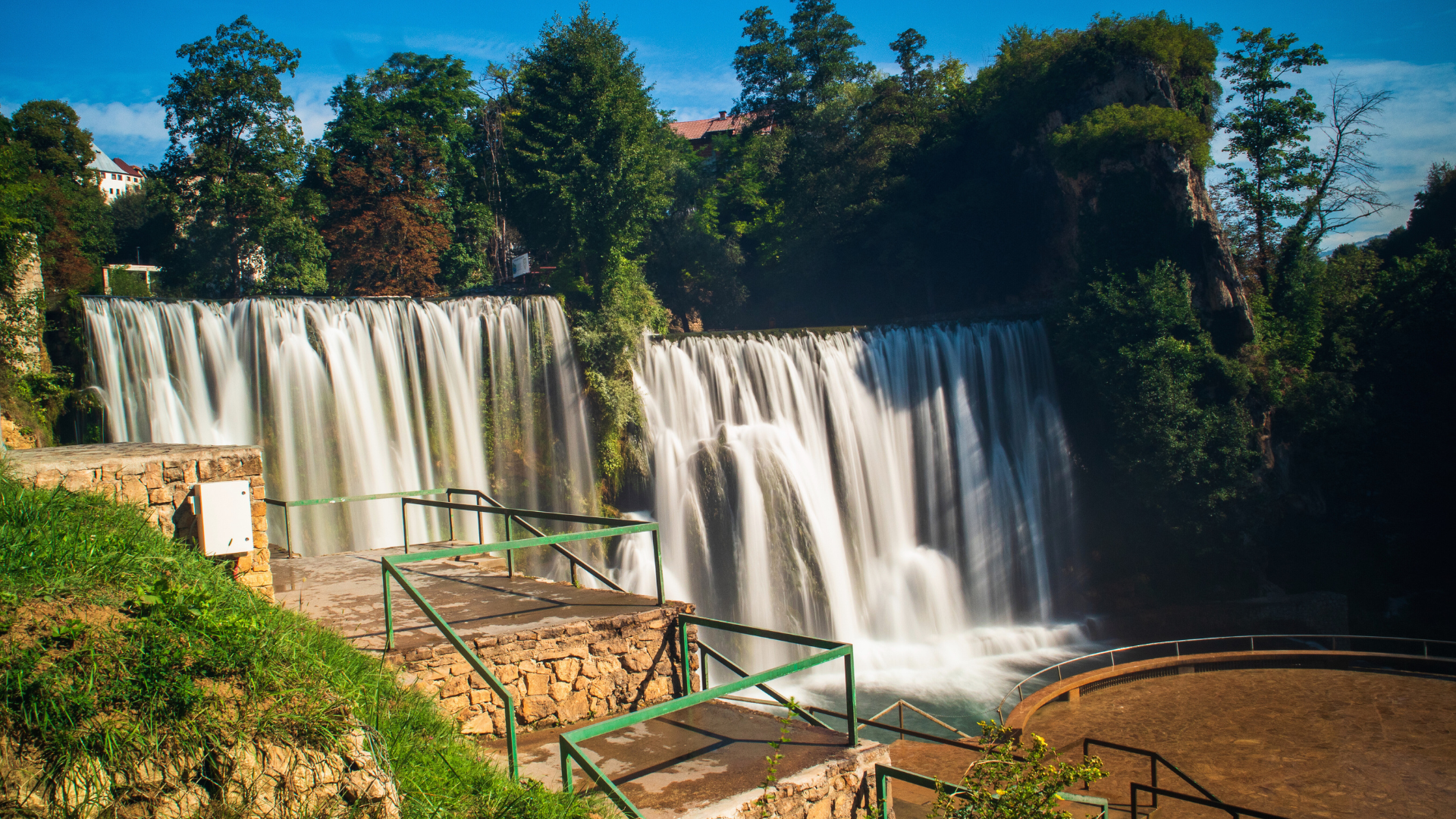
Pliva Waterfall
The waterfall is unique in Europe not only for its beauty, but for where it stands and what it has witnessed.
Here, the Pliva River drops straight down into the Vrbas River.
Height: around 21 meters
The waterfall is naturally formed through limestone deposits and erosion over thousands of years.
Unlike many other waterfalls, Pliva has shifted position over time, as the limestone grows and breaks down simultaneously.
Pliva Waterfall falls as it always has.
Day after day.
Century after century.
When you stand here today, you hear only the roar.
But the water has heard cries, prayers, screams and silence.
When the area became part of Ottoman Bosnia in the 1400s, the waterfall was not a tourist attraction.
It was a condition for life.
People gathered here.
Trade routes between East and West passed through this place.
Through the centuries, the waterfall watched rulers change, nations rise and fall.
The town above transformed, languages shifted, flags were raised and torn down.
Pliva continued to fall untouched, but never unaware.
Today, Pliva is photographed from every angle.
But for many locals, it is more than a picture.
It is a place where memories remain.
Children play where their parents once fled.
Coffee is shared where grief once felt heaviest.
This is not forgetting.
This is survival.
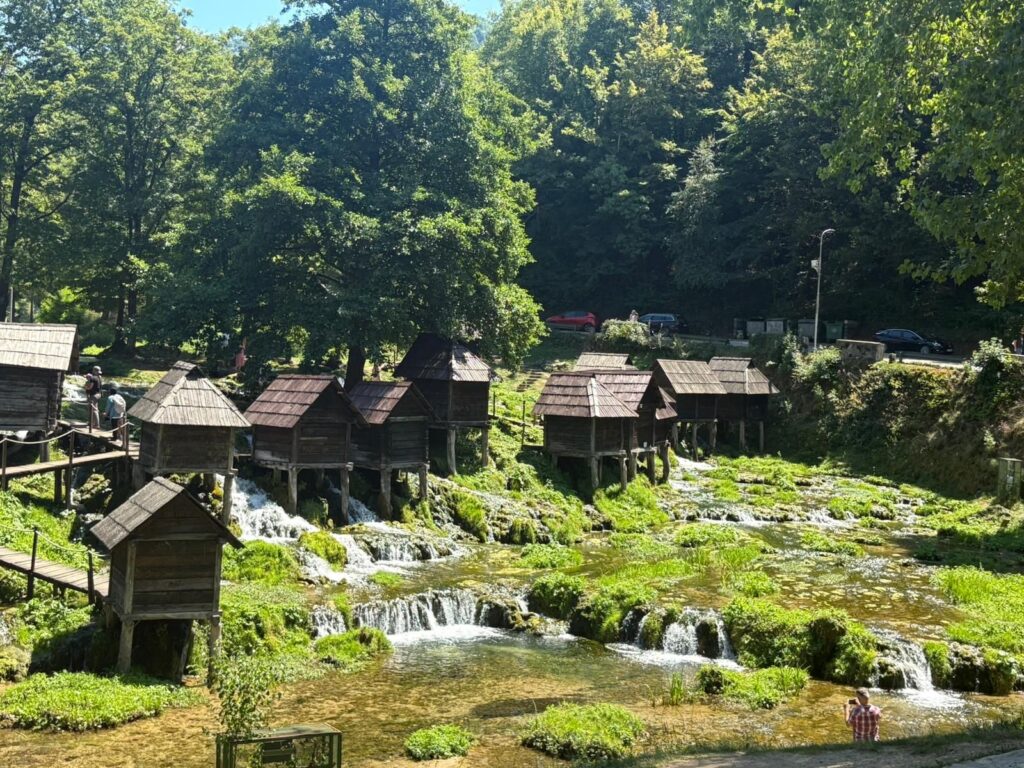
Mlincic
Once upon a time, watermills could be found almost everywhere.
Every community with running water built them.
They were as natural and necessary as bread on the table.
But the world changed.
Machines took over.
Electricity replaced waterpower.
Small, local systems became unnecessary.
And the mills disappeared, one by one.
Mlincici is unique in many ways not because of its size, but because of its idea.
All the mills are the same: the same size, the same access to water, the same purpose.
This was intentional.
No one was meant to stand above anyone else.
What is unusual is not that they were built, but that they remain together.
Today, finding a watermill is rare.
Often it is a ruin, or a single building turned into a museum.
Here, you don’t just see old structures.
You see traces of a way of life that has almost completely disappeared.
The water still flows.
The mills stand still.
But the story is alive.
Here, the water is divided into narrow streams.
Each mill receives its share.
No more.
No less.
The mills stand close, almost leaning toward one another.
They are equally sized, equally simple, equally important.
Mlincici shows how people once built for cooperation not for excess.
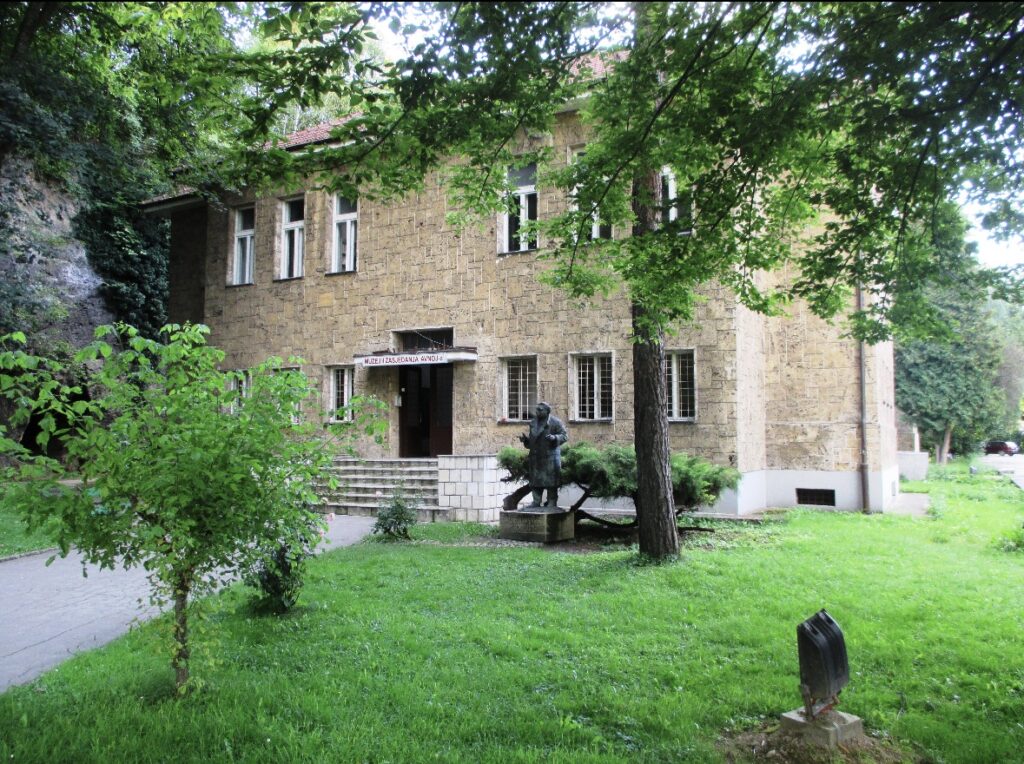
AVNOJ museum
It is November 1943.
Snow lies heavy on the cobblestone streets of Jajce.
The war is raging across Europe, but here inside a simple building with cold walls and worn benches people gather carrying something more dangerous than weapons: an idea.
They arrive on foot, on horseback, in secrecy.
Partisans, intellectuals, farmers, leaders.
Serbs, Croats, Bosniaks, Slovenes, Montenegrins.
People who once stood on different sides, now sharing the same vision of the future.
The air in the hall is dense.
Not with fear, but with gravity.
This is the Second AVNOJ Session.
And here, a decision is made that none of them can fully grasp in that moment:
The old Yugoslavia is finished.
A new one will be born built on equality, not monarchy.
No king.
No rule from above.
Instead: the voice of the people.
In this moment, it is declared that Yugoslavia will become a federation of equal republics.
Bosnia and Herzegovina is recognized not as an appendix, but as its own identity.
A land where different peoples and religions are meant to live side by side.
It is a bold decision.
A dangerous one.
But also a hopeful one.
Outside, the war continues.
Inside, the future is being written.
Many of those sitting in the room will not live long enough to see peace.
But their words will outlive them.
When you step into the AVNOJ Museum in Jajce, it is not just a museum.
It is a reminder that even in the darkest moment of war, a town, a room, and a handful of brave people tried to create something larger than themselves.
And it began here.
In Jajce.

The Catacombs of Jajce
Deep inside the mountain, just beneath the old town of Jajce, opens a place that feels more whispered than told.
The catacombs of Jajce are not an ordinary underground chamber they are hand‑carved into stone, created in the 1400s during a time when Bosnia stood at the crossroads of religious, political, and cultural upheaval.
Down here, the air is cool.
Sounds soften.
Time slows.
The catacombs are believed to have been built on the orders of the Bosnian nobility, possibly connected to King Stjepan Tomaš and the influence of the Bosnian Church.
The space served both as a sanctuary and a burial site, and its symbolism is powerful: crosses, niches, and stone reliefs speak of a spirituality that lived in the shadow of the approaching Ottoman Empire.
This is not a place of grandeur.
It is a place of reflection.
Here, life and death meet.
Power and humility.
Faith and uncertainty.
When you stand inside the catacombs, you are literally standing in the heart of medieval Jajce in a chamber that has survived kingdoms, wars, and centuries of change.
The walls bear the marks of hands that worked in darkness, not to impress, but to leave something that would endure.
For many visitors, this is the most emotionally powerful place in Jajce.
Not because of what you see, but because of what you feel.
The catacombs remind us that Jajce is not only a city above ground, with fortresses and waterfalls, but also a city with depth both literal and historical.

Jajce Fortress
High above the town, where the rivers Pliva and Vrbas meet, rises the Jajce Fortress a place that has watched over Bosnia for more than six centuries. Built in the late 1300s and expanded under the Bosnian Kingdom, it became the seat of the last Bosnian kings, including Stjepan Tomašević.
The fortress later passed through the hands of Ottomans, Hungarians, and Austrians, each leaving their mark on its walls. Yet its silhouette has remained almost unchanged: strong, quiet, and unmistakable.
Walking through the gates today, you step into a space where armies once marched and kings once ruled. The stone walls carry the weight of battles, sieges, and shifting empires but also moments of peace, trade, and everyday life.
From the top, the view opens over Jajce’s waterfalls, rooftops, and mountains. It becomes clear why this place mattered. It was not only a fortress. It was a symbol of identity, resilience, and the crossroads of cultures.
Jajce Fortress stands as it always has guarding the town, telling its story without a single word.